
Alfalfa County Arrest Records and Court Charges
An Alfalfa County arrest record is the account of an arrest itself. It shows who was taken into custody, the agency that made the arrest, and the booking that followed. The Sheriff runs the county jail and books people in. That side of the story sits with law enforcement. An arrest does not prove guilt. It means an officer had probable cause to believe a crime took place. The booking record and any custody status are the law-enforcement half of the picture.
The court charge record is a separate file. After an arrest, the District Attorney reviews the police reports and decides what to file. Those court charges after arrest are entered with the Court Clerk, and the case begins. Booking detail, bond, and custody status live on the Alfalfa County inmate records side, while the charges move through the District Court. The full case file, with pleas, hearings, and the final outcome, sits in the Alfalfa County criminal court records.
This page leads with the charges because they are what the court tracks. The arrest opens the door. The charge is what the State must prove.
How Alfalfa County Charges Get Filed
The arrest happens first, at booking. The charge record begins later, when a prosecutor files a charging document with the court. In Oklahoma, the local District Attorney's overview explains the flow plainly: police investigate, submit reports, and a prosecuting attorney decides whether to charge. A criminal case starts when the prosecutor files a complaint or an officer files a citation. The charge record is that charging document and the docket entries tied to it, not the arrest booking sheet.
Three kinds of charging documents open most cases. Each one names the accused and lists the offenses. The table below sets them side by side so the differences are clear.
| Document | Filed By | Typical Use | What It Is |
|---|---|---|---|
| Complaint | Officer or prosecutor | Misdemeanors and case start | The charging paper or citation that opens a case. |
| Information | Prosecutor (DA) | Many felonies | A sworn charge the District Attorney files directly with the court. |
| Indictment | Grand jury | Serious felonies | A formal charge returned by a grand jury after it reviews the evidence. |
One arrest can lead to one charge or to several. The number and level of charges depend on what the prosecutor can support, not on the count an officer wrote at the scene.
Who Files Charges in Alfalfa County
The District Attorney decides the charges in Alfalfa County. The office is led by District Attorney Christopher Boring, with Assistant District Attorney Jeremy Bays, and it serves a five-county district that also covers Dewey, Major, Woods, and Woodward counties. The local office sits in the courthouse at 300 S. Grand Ave, Suite 7, in Cherokee. The DA prosecutes crimes committed within the district, assists grand juries, draws indictments when needed, and helps victims through the process. It does not give legal advice or handle civil suits.
The same office runs programs that can shape how a charge is resolved. Its Restitution and Diversion Division, based in Woodward, collects victim restitution and oversees diversion for eligible defendants. You can read about that division on the Alfalfa County District Attorney's restitution and diversion page.
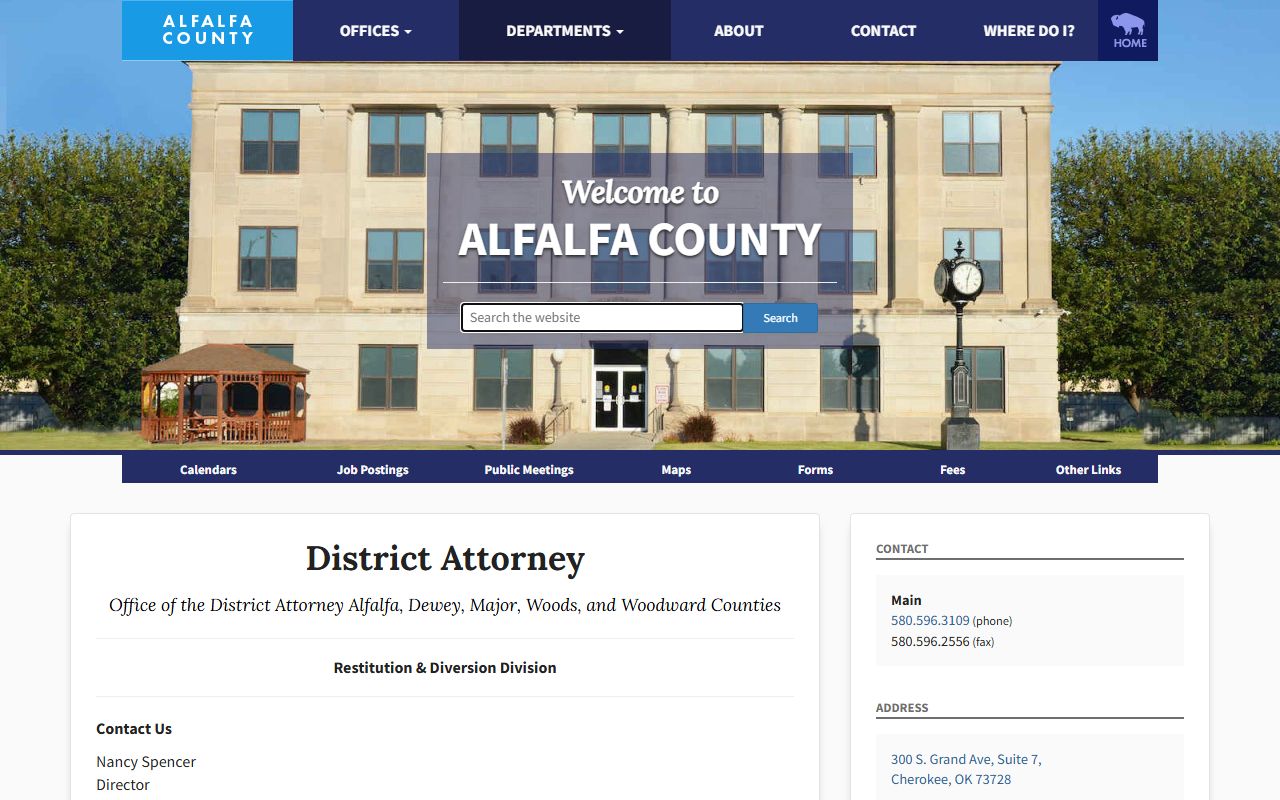
Diversion matters for the charge record because a completed program can lead to a reduced charge or a dismissal. The victim-witness coordinator, also in Woodward, helps with case status, restitution, and crime-victim compensation. So an Alfalfa charge may have a court file in Cherokee while parts of the program contact run out of Woodward.
Charge Codes and Severity Levels
Every charge ties back to a statute. The charging document cites the law the State says was broken, and the case number prefix flags the level. In Alfalfa County court searches, a CF prefix marks a felony and a CM prefix marks a misdemeanor. A single arrest can produce several separate charges, each with its own code and its own level.
Severity drives almost everything that follows: bond, the court track, and the possible sentence. The short glossary below defines the levels you will see most often in Oklahoma charge records.
- Felony
- A more serious offense that can carry a year or more in state custody. Felony cases often start by Information or indictment.
- Misdemeanor
- A lower-level offense, usually punishable by jail time under a year, a fine, or both. Most start by complaint or citation.
- Count
- One charged offense. A case with three counts lists three separate charges the State must prove.
Note: A charge level can shift as a case moves, so the code shown at filing is not always the level a defendant faces at the end.
Charge Status in Alfalfa County Court Records
Charges are not fixed once they are filed. As a case moves, the prosecutor can amend, reduce, add, drop, or dismiss them. The court docket records each change, so the status field tells you where a charge stands right now. Reading it correctly keeps you from treating an old, dropped charge as if it were still live.
| Status | What It Means |
|---|---|
| Pending | The charge is filed and active, and the case has not reached a final outcome. |
| Amended / Reduced | The prosecutor changed the charge, often to a lower level or a different count. |
| Dismissed | The court dropped the charge, so it no longer moves forward in the case. |
| Nolle Prosequi | The prosecutor chose not to pursue the charge and ended it. |
A dismissal or a nolle prosequi can still leave a record of the original charge on the docket. That is why people who want the entry sealed look at expungement, covered further down.
Find Alfalfa County Arrest Records
Charges and charge status show up in the District Court case search. Alfalfa County links its court records to the On Demand Court Records system, known as ODCR, and the state judiciary runs OSCN as a second route. The arrest and booking side is not in these portals; for jail and custody detail, the county points readers to the Sheriff. The steps below walk through a charge search.
- Open the ODCR court search and choose Alfalfa under the Court menu, or leave the court group set to Oklahoma District Courts.
- Search by defendant name in Last, First format, or enter a full case number if you have one.
- Open the case and read the charge list, including each count and the statute it cites.
- Check each charge for its code, its level, and its current status before you draw any conclusion.
If ODCR does not show a case, try the OSCN case-number lookup, which lists Alfalfa County District Court and offers daily filings and docket reports. When a document will not open online, or a case is older than the online coverage, call the Court Clerk in Suite 8 at 580-596-3523. The clerk's case file is the official record; the online portals are a convenient copy.
Charges vs. Convictions
A charge is an accusation. A conviction is a result. Seeing a charge in Alfalfa County arrest records tells you the State accused someone, not that a court found them guilty. The gap between the two is large, and the law treats them very differently. The comparison below lays out the line between an open charge and a final conviction.
| Charge | Conviction | |
|---|---|---|
| Stage | Accusation | Verdict or plea |
| Burden of Proof | Probable cause | Beyond a reasonable doubt |
| Meaning | Accused, not proven | Guilt established |
| Public Record | Yes | Yes |
Both stages are public, so a dropped charge can still surface in a search long after the case ends. That is one reason a careful reader checks the disposition, not just the charge.
Statewide Lookups for Alfalfa County Charges
Local court searches show charges case by case. A statewide criminal history pulls them together across Oklahoma. The Oklahoma State Bureau of Investigation runs a name-based system called CHIRP for this purpose. A search there returns charges and dispositions reported from courts and agencies across the state, which is broader than a single county docket.
Using OSBI CHIRP takes a free account, and each record search carries a fee. A date of birth is required for a name search, and results expire after a set window, so save what you need. OSBI also provides background-check guidance grounded in the Oklahoma Open Records Act. For state-sentenced offenders rather than charges, the Oklahoma Department of Corrections offender lookup is the matching tool.
Note: CHIRP reflects what agencies reported to the state, so a very recent Alfalfa County charge may appear on the local docket before it reaches the statewide record.
Release Conditions After an Alfalfa County Arrest
Between the arrest and the first hearing, a defendant may be released under conditions. The local District Attorney's criminal-case overview describes the terms an arrested person signs to get out. These conditions are part of the early case record, and breaking them can add new entries or a warrant.
- Agree to appear at every scheduled court date.
- Remain in the state unless the court grants permission to leave.
- Avoid direct or indirect contact with the alleged victim.
The first court appearance after an arrest or citation is the arraignment. The defendant is formally told the charges and enters a plea. Pleas, hearings, and any settlement or trial follow from there, and each step lands on the docket. Bond amounts and custody questions go to the Sheriff's Office, while the charge and hearing record stays with the Court Clerk.
Background Checks and Alfalfa County Charge Records
There is a difference between a casual name search and a formal background check. A quick look at a court docket can tell you whether a charge exists. A regulated background check, the kind used for hiring or housing, must follow the federal Fair Credit Reporting Act and pull from a compliant source. The two are not the same, and a casual docket peek should never be treated as a vetted report.
For a formal Oklahoma history, the OSBI CHIRP record and a licensed screening provider are the proper routes. A free court search is fine for personal awareness, but it can miss sealed entries, recent updates, or charges filed in another county.
Important: This site is not a consumer reporting agency under the Fair Credit Reporting Act, and its information may not be used to decide credit, employment, housing, or insurance.
Sealed vs. Expunged Charge Records
People often want a charge record cleared, especially after a dismissal or an acquittal. Oklahoma offers two related paths, and they are not identical. Sealing hides a record from public view. Expungement goes further and treats qualifying records as if they never existed. The eligibility rules and the cost differ, as the comparison shows.
| Sealed | Expunged | |
|---|---|---|
| Visibility | Hidden from public view | Treated as if it never existed |
| Law Enforcement | Limited access | Very limited access |
| Eligibility | Set by 22 O.S. § 18 | Granted by court order under 22 O.S. § 19 |
| Cost | Court-record expungement is free | Arrest-record expungement adds a $150 OSBI fee |
Eligibility for clearing a charge or arrest record is set by statute. You can read the eligibility rules in 22 O.S. § 18, which lists who may ask the district court to seal a qualifying record.
The procedure that follows is its own statute. After eligibility is confirmed, the petition and the sealing process run under 22 O.S. § 19, which tells agencies how to seal records once a court signs the order. In Alfalfa County, the petition is filed in the District Court through the Court Clerk.
OSBI guidance notes that expunging the court record is free, while expunging the arrest record carries a $150 OSBI processing fee and may add local law-enforcement costs. The two steps are separate, so a cleared court file does not automatically clear the arrest record.
Note: Sealing and expungement do not happen on their own, and a record stays public until a judge signs the order that directs each named agency to seal it.
Restricted Charge Records in Alfalfa County
Not every charge record is open. Some are closed by law from the start, and others are withheld while a case is active. Knowing which charges fall outside a public search keeps your expectations realistic.
Juvenile charge records are the clearest example. Under 10A O.S. § 2-6-102, most juvenile court records are confidential, and access usually requires party status or a court order. Sealed and expunged charges drop out of public view once an order is signed. Charges that were dismissed may be withheld in some contexts, and details from an ongoing investigation can stay out of the public file until the case is charged or closed.
When a record will not appear online, the fallback is the office that holds it. For court charges, that is the Court Clerk in Suite 8. For criminal history, that is OSBI CHIRP. For booking and custody, that is the Sheriff's Office. Each office controls a different slice of the arrest-to-charge record.